Why Trauma-Informed Care Must Move Beyond Awareness
Why Trauma-Informed Care Must Move Beyond Awareness.
Across the country, organizations are investing in trauma-informed training. Schools, hospitals, nonprofits, and government systems are all asking the same question:
How do we better serve people with complex needs?
But there’s a problem no one is talking about:
Most trauma-informed training isn’t transforming systems.
It’s informing them.
There’s a difference.
The Gap Between Awareness and Implementation
Many trainings focus on:
What trauma is
The science of ACEs
General principles like safety, trust, and empathy
This knowledge is important, but knowledge alone doesn’t change outcomes.
Because when staff return to their environments, they’re still navigating:
High stress
Burnout
Reactive behaviors
Inconsistent leadership
Systems not designed for regulation
And without structure, people default back to what they know.
Trauma Shows Up in Systems. Not Just Individuals
Unresolved trauma doesn’t just live in people.
It shows up in:
Communication breakdowns
Escalation cycles
Staff turnover
Policy decisions
Organizational culture
If we only train individuals and don’t address systems, we miss the root issue.
What Systems Actually Need
To become truly trauma-informed, organizations need more than training.
They need:
A framework for consistent implementation
Tools for real-time regulation and response
Leadership alignment
Clear standards for what trauma-informed practice looks like in action
Introducing the STRONG™ Framework
At the National Trauma Information & Inclusion Training Center (NTITC), we developed the STRONG™ Framework to close this gap.
It moves organizations from:
Awareness → Application
Reaction → Regulation
Inconsistency → System-wide alignment
Because trauma-informed care isn’t a mindset.
It’s a system of practice.
The Future of Trauma-Informed Systems
The organizations that will lead in the next decade are not the ones that simply “train their staff.”
They are the ones who:
Operationalize trauma-informed principles
Build cultures of regulation and clarity
Create environments where both staff and clients feel safe
Final Thought
When we lead with safety, clarity, and consistency, we don’t just improve interactions.
We transform systems.
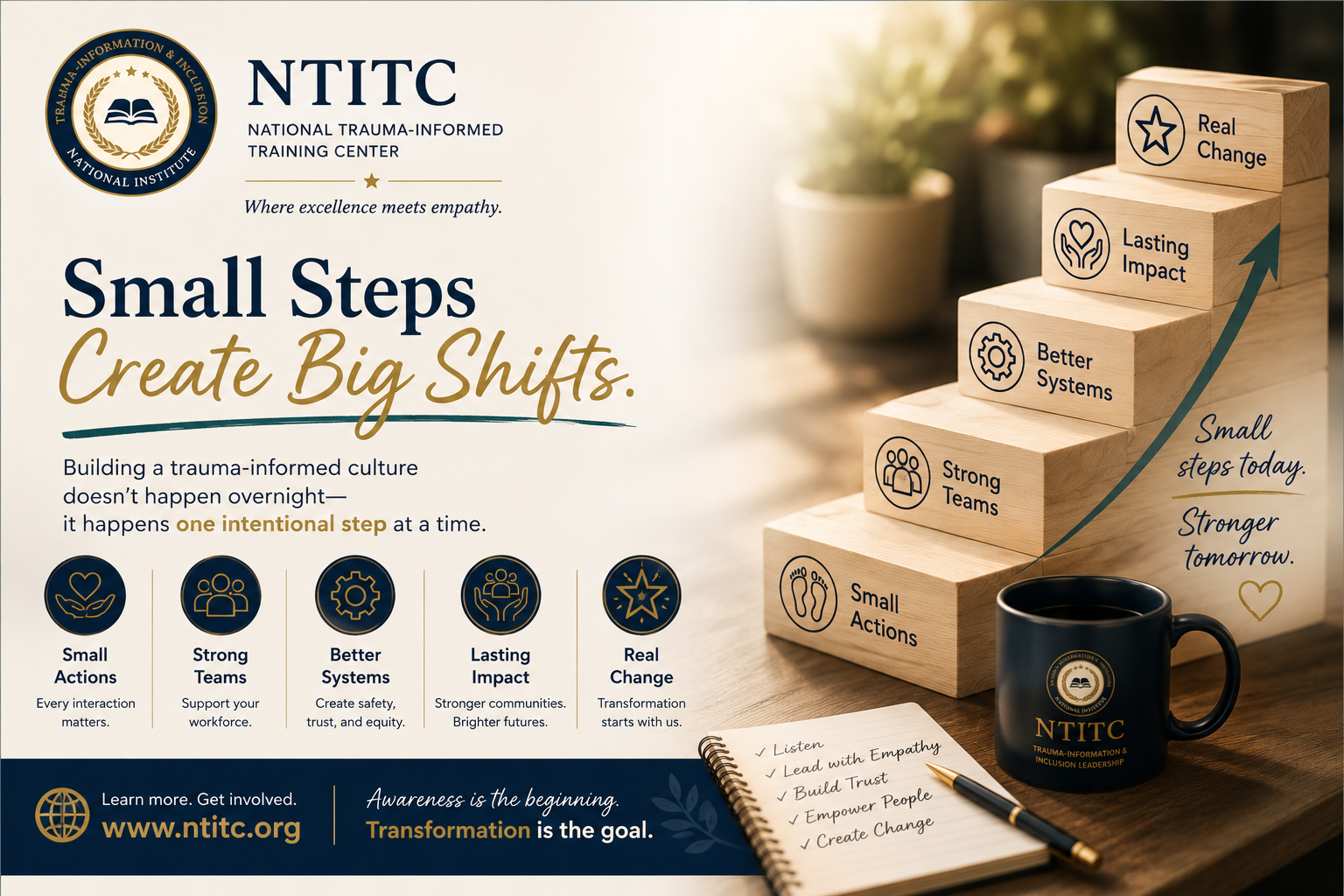
Small Steps Create Big Shifts
One of the most powerful truths about building a trauma-informed culture is this: transformation does not always begin with massive overhauls. More often, it begins with small, intentional shifts repeated consistently over time.
Organizations sometimes assume trauma-informed care requires a complete redesign of systems, staffing, or operations before meaningful change can happen. While long-term systemic change is important, sustainable transformation is often built through everyday moments, such as the tone of a supervisor’s response, the way policies are communicated, how staff are supported after difficult incidents, or whether people feel psychologically safe enough to speak honestly without fear of punishment or shame.
Small steps create cultural momentum.
For frontline workers, this may look like taking an extra moment to regulate before responding to someone in crisis, practicing curiosity instead of judgment, or recognizing that behaviors are often rooted in survival rather than defiance. It may mean learning how to pause long enough to ask, “What happened to this person?” instead of “What is wrong with them?” These moments may seem small, but repeated daily, they begin to reshape environments, relationships, and outcomes.
For supervisors and middle management, small shifts can include checking in with staff after high-stress incidents, normalizing conversations around burnout and secondary traumatic stress, or creating spaces where employees feel seen, valued, and emotionally supported. Trauma-informed leadership is not a weakness. It is strategic leadership rooted in emotional intelligence, workforce sustainability, and human-centered decision making.
For executive leadership and decision makers, the shift often begins with perspective. Trauma-informed organizations understand that culture is not created by mission statements alone — it is created by policies, systems, expectations, communication, and how people are treated under pressure. A trauma-informed culture asks critical questions:
Are our systems helping people heal or causing additional harm?
Are we supporting the workforce expected to carry this mission forward?
Do our policies reflect empathy, accountability, inclusion, and sustainability?
Are we building environments where people can function at their best, or simply survive?
The reality is that organizations do not become trauma-informed overnight. They become trauma-informed through consistent choices made at every level of leadership and service delivery.
A single policy revision can improve staff retention.
One supportive supervisor can reduce burnout.
One emotionally safe interaction can change how someone experiences an entire organization.
One organization willing to lead differently can influence an entire community.
This is how culture shifts happen.
Not through perfection.
Not through performative language.
But through intentional action, practiced consistently enough that empathy, safety, trust, and accountability become embedded into the organizational DNA.
The goal is not to “do trauma-informed care perfectly.” The goal is to create environments where people, both those being served and those doing the serving, can function, grow, and thrive.
Because when small steps are aligned with intentional vision, they create transformational impact.
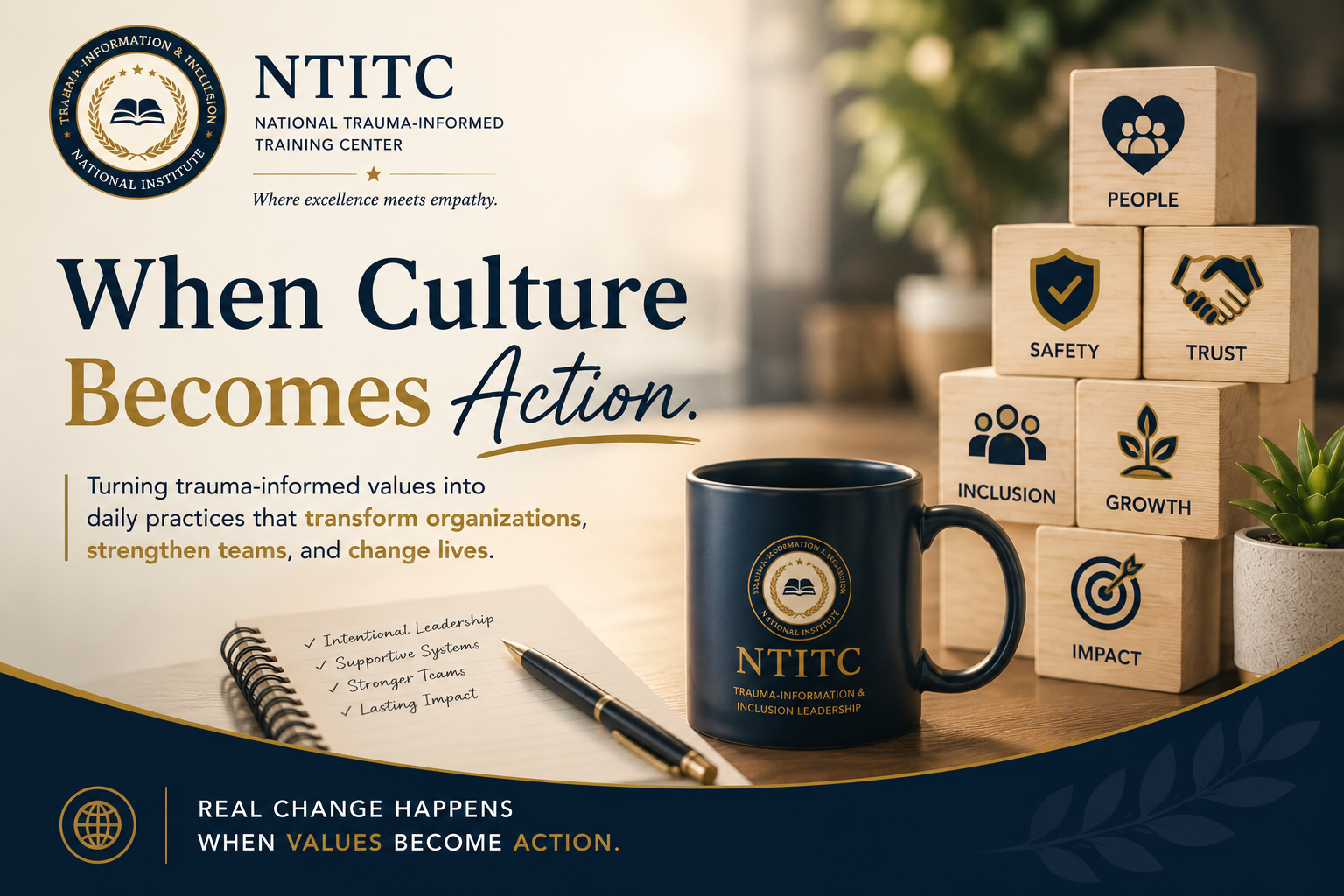
When Culture Becomes Action
Trauma-informed care cannot survive as a slogan, a yearly training, or a checkbox on an organizational initiative plan. Real transformation happens when trauma-informed values move beyond intention and become embedded in the daily culture of an organization.
This is where many organizations struggle.
They care deeply.
They want to help.
They may even understand the impact trauma has on individuals, families, communities, and workforces.
But understanding trauma and operationalizing trauma-informed practices are two very different things.
Culture becomes action when the principles of safety, trust, empathy, inclusion, accountability, and sustainability begin influencing not only how services are delivered but how organizations function internally.
It is reflected in:
leadership decisions
hiring practices
supervision styles
policy development
communication patterns
crisis response
employee wellness
team dynamics
organizational expectations
workplace safety
workforce sustainability
A trauma-informed organization is not simply identified by what it says publicly. It is revealed by how people experience the organization privately.
Do employees feel psychologically safe?
Are frontline workers supported after high-stress incidents?
Can staff speak honestly without fear of retaliation or humiliation?
Are leaders modeling emotional regulation and accountability?
Do systems prioritize both performance and people?
These questions matter because culture is not built during presentations or mission statements. Culture is built through repeated daily experiences.
For frontline professionals, trauma-informed culture can mean working in environments where they are trusted, supported, and emotionally equipped to continue serving high-need populations without sacrificing their own well-being.
For supervisors, it means recognizing that leadership is not simply operational management; it is emotional influence. Every interaction has the potential to either strengthen or fracture organizational trust.
For executive leadership and decision makers, trauma-informed action requires courage. It requires organizations to move beyond performative language and examine whether existing systems unintentionally contribute to burnout, turnover, fear, disengagement, or harm.
The reality is that many helping professionals enter this work with passion, purpose, and commitment. Yet over time, unsupported environments can slowly erode even the strongest workforce.
This is why trauma-informed systems are no longer optional.
Organizations cannot sustainably serve people through chronically overwhelmed systems and emotionally depleted staff. Workforce wellness is not separate from organizational outcomes; it directly impacts them.
When culture becomes action:
communication becomes more intentional
Leadership becomes more emotionally intelligent
systems become more human-centered
Accountability becomes healthier
Staff retention improves
trust increases
burnout decreases
outcomes strengthen
Most importantly, people begin to feel the difference.
Not because the organization claimed to be trauma-informed,
but because they experienced it.
Transformation happens when values stop living only in vision statements and begin showing up in everyday actions, policies, leadership decisions, and workplace culture.
Because trauma-informed care is not just something organizations say.
It is something people should be able to feel.
Supporting the Workforce Behind the Mission
Behind every crisis response, every difficult conversation, every exhausted shift, every child protected, every family supported, and every life impacted, there is a workforce carrying the emotional weight of the mission.
And too often, that workforce is silently struggling.
Helping professionals enter this work because they care deeply. They are driven by purpose, compassion, service, and the desire to make a difference in the lives of others. But passion alone cannot sustain people working inside chronically overwhelmed systems without adequate emotional support, psychological safety, or organizational sustainability.
This is one of the greatest challenges facing high-impact organizations today.
Across healthcare, behavioral health, education, social services, child welfare, homelessness services, crisis response, nonprofit leadership, and public service sectors, professionals are being asked to carry increasingly complex emotional and operational demands and often while navigating staffing shortages, burnout, secondary traumatic stress, compassion fatigue, and systems that were never designed to sustain the weight of the work.
The reality is this:
You cannot build trauma-informed organizations while ignoring the well-being of the workforce expected to carry the mission forward.
Supporting the workforce is not separate from organizational outcomes.
It is directly connected to them.
When staff feel unsupported, unheard, emotionally exhausted, or psychologically unsafe, organizations begin experiencing:
increased turnover
decreased morale
disengagement
compassion fatigue
burnout
communication breakdowns
retention challenges
decreased effectiveness
fractured workplace culture
But when organizations intentionally invest in workforce wellness, something powerful begins to happen.
Trust increases
Teams become stronger
Communication improves
Retention stabilizes
Leadership becomes healthier
Culture becomes safer
And the people being served ultimately receive better care and support
Trauma-informed systems recognize an important truth:
The people doing the helping also need support.
This does not mean lowering expectations or removing accountability. It means understanding that emotionally healthy teams are more effective, sustainable, collaborative, and resilient over time.
For frontline professionals, support may look like:
emotionally safe supervision
opportunities for debriefing
manageable expectations
access to wellness resources
leadership that listens
feeling valued beyond productivity metrics
permission to be human while doing difficult work
For supervisors and leadership teams, it means recognizing that workforce wellness is not a “soft issue.” It is a strategic priority directly tied to organizational performance, retention, culture, and long-term sustainability.
Organizations that fail to support their workforce often spend enormous amounts of time and resources reacting to crises caused by burnout, turnover, disengagement, and instability.
Organizations that proactively support their workforce build stronger systems from the inside out.
Sustainable missions require sustainable people.
And perhaps one of the most overlooked realities in helping professions is this:
Many of the individuals serving high-need populations are carrying their own life experiences, stressors, trauma histories, grief, and emotional burdens while continuing to show up every day to care for others.
That level of emotional labor deserves acknowledgment.
It deserves leadership awareness.
And it deserves systems intentionally designed to support the humans behind the mission.
Trauma-informed organizations understand that caring for the workforce is not a distraction from the mission.
It is part of the mission.
Because when organizations begin supporting the people doing the work, they strengthen the very foundation the work depends on.